On this page
- Planning and best time
- Safety
- Visas and entry
- Money, cards and connectivity
- Getting around
- Itineraries and day trips
- Pamir Highway
- Seven Lakes, Fann Mountains and Iskanderkul
- Culture, food and drink
- Solo, women and LGBTQ+ travellers
- Costs, tours and language
- Photography and drones
- Plan your trip with TravelX
- Sources
Uzbekistan and Tajikistan are next-door neighbours, and more and more travellers visit both in one trip. The same questions come up again and again: Is it safe? Do I need a visa? Will my card work? Can I get train tickets? How hard is the Pamir Highway? This FAQ answers the 47 questions we see most often, in short and honest answers. Where a topic needs more detail, we point you to the full guide in the TravelX journal.
Rules in both countries changed often in 2025 and 2026. We checked every answer on 19 October 2026, but please check visa and entry rules again shortly before you travel.
How we chose these questions. We reviewed what travellers ask in recent forum threads (Tripadvisor, Eurasia.Travel, Mumsnet), the FAQ sections of leading travel guides and blogs, and the questions our own clients ask us most on WhatsApp and by email. The order inside each section roughly follows how often a question comes up.
Planning and best time
When is the best time to visit Uzbekistan and Tajikistan?
For the Silk Road cities (Tashkent, Samarkand, Bukhara, Khiva), the most comfortable months are April–May and September–October. Days are warm and evenings are cool. July and August are very hot in the lowlands, with average highs of 35–37°C and many days above 40°C. Summer, however, is the best season for the mountains: late June to September for the Pamir Highway, and June to September for the Fann Mountains, Iskanderkul and the Seven Lakes. Winter is quiet and atmospheric but cold. See our guide: What to Wear and Pack for Uzbekistan and Tajikistan: A Season-by-Season Guide.
How many days do I need for Uzbekistan?
Seven to ten days is enough for the classic route of Tashkent, Samarkand, Bukhara and Khiva at a comfortable pace. With five or six days you can see Tashkent, Samarkand and Bukhara, but you will feel rushed. With two weeks you can add the Fergana Valley, Shakhrisabz, a desert yurt camp or a trip across the border to Tajikistan. Our ready-made Silk Road tours run for 6 days and 8 days, and we can adjust them or plan a longer route for you.
How long should I spend in Samarkand, Bukhara and Khiva?
Most travellers are happy with two nights in Samarkand, two nights in Bukhara and one or two nights in Khiva. Tashkent needs one full day for the main sights. Khiva is small, and its old town (Ichan Kala) can be seen in a day, but staying overnight lets you see it in the quiet early morning and at sunset. If you must choose between Bukhara and an extra day in Samarkand, we usually suggest Bukhara: it feels very different and is only about 1.5–2 hours away by high-speed train.
Can I combine Uzbekistan and Tajikistan in one trip?
Yes, and it is easier than ever. Seven land crossings between the two countries are open to foreigners, and six of them work 24 hours a day. The two most popular are Jartepa–Sarazm (Samarkand–Panjakent) and Oybek–Fotehobod (Tashkent–Khujand). Many travellers do a Seven Lakes day trip from Samarkand, or travel overland from Samarkand to Dushanbe through the Fann Mountains. Check that your visa covers every entry: if you leave and come back, you may need a double or multiple-entry e-visa. See our guides: Uzbekistan Land Border Crossings: 2026 Guide and Tajikistan Land Border Crossings: 2026 Guide.
Is it a good idea to travel during Ramadan or Navruz?
Yes, with a little planning. During Ramadan, cafés and restaurants in the cities usually stay open, but opening hours can change, and it is polite not to eat or drink openly near mosques. In 2027, Ramadan is expected to start around 8 February. Navruz (21 March) is a lively spring festival, but trains and border posts are much busier around it, and tickets sell out. Book trains early if your dates include Navruz or the Eid holidays.
Safety
Is Uzbekistan safe for tourists?
Yes. Uzbekistan is generally a very safe country to visit. The US State Department rates it Level 1, “Exercise normal precautions” (January 2026). Violent crime against tourists is rare. The main risks are pickpockets in busy bazaars, unofficial taxis and card skimming, so use taxi apps or booked transfers and ATMs inside banks. There is a tourist police hotline: 1173.
Is Tajikistan safe, including the Pamirs and the Afghan border?
Most of Tajikistan, including Dushanbe, Khujand, the Fann Mountains and the Seven Lakes, is generally safe for visitors. The US State Department rates Tajikistan Level 2, “Exercise increased caution” (September 2026), and advises travellers to reconsider travel to Gorno-Badakhshan (GBAO, the Pamirs) and to areas near the Afghan border. The UK government updated its advice in August 2026 after armed incidents near the Afghan border, and GBAO permits can be suspended at short notice. Many travellers still drive the Pamir Highway every summer, but you should read the latest government advice before you book and again before you go. The Wakhan Valley route runs directly along the Afghan border, the area both governments flag. Check that your travel insurance covers GBAO, and stay on the road near the border, because there are minefields. See our guide: Tajikistan Visa Rules: The Complete 2026 Guide.
Visas and entry
Do I need a visa for Uzbekistan?
Probably not. Citizens of 93 countries can visit Uzbekistan visa-free, usually for up to 30 days. The list includes the EU, the UK, Canada, Australia, Japan, South Korea, the Gulf states and, since 1 January 2026, the United States. Most other nationalities can get an e-visa at e-visa.gov.uz (USD 20 for single entry, normally issued in 2 working days). Use only the official site, as many look-alike sites charge much more. See our guide: Uzbekistan Visa Rules: The Complete 2026 Guide.
Do I need a visa for Tajikistan?
Citizens of about 90 countries, including the US, Canada, Australia, Japan, South Korea and EU countries, can enter Tajikistan visa-free for up to 30 days. Some nationalities still need a visa, including the UK, Türkiye, India, Israel and Pakistan. Most of them can apply for an e-visa at evisa.tj (USD 30 single entry, USD 50 multiple entry). Apply at least 2–3 weeks before travel, as processing times vary. Visa-free visitors and e-visa applicants do not need an invitation. If you apply for an embassy visa that needs a letter of invitation, TravelX can help arrange it; the Tajik Foreign Ministry makes the final decision. See our guide: Tajikistan Visa Rules: The Complete 2026 Guide.
Do I need to register after I arrive?
In Uzbekistan, every visitor must be registered within 3 days of arrival. Hotels and licensed guesthouses do this automatically, so most travellers do nothing. If you stay in a private apartment or camp, you or your host must register you on emehmon.uz. Keep your registration slips until you leave. In Tajikistan, e-visa holders do not need to register. Visa-free visitors who stay longer than 10 working days must register with the migration office (OVIR).
What should I not bring into the country?
Leave your drone and your vape at home. Drones are effectively banned in Uzbekistan without special permits and undeclared drones are confiscated at the border, and Tajikistan requires advance government permission. Vapes and e-cigarettes have been fully banned in Uzbekistan since 1 March 2026, including for import. Be careful with medicines that contain codeine, tramadol or other controlled substances: carry them in the original packaging with a prescription and a doctor’s letter, and check with the embassy first. Declare cash above about USD 8,000 when entering Uzbekistan, and above USD 10,000 when entering Tajikistan.
Money, cards and connectivity
Can I pay by card in Uzbekistan, or do I need cash?
You need both. Visa and Mastercard are accepted in many hotels, larger restaurants and supermarkets in the main cities, and ATMs are common in Tashkent, Samarkand and Bukhara. Bazaars, small cafés, guesthouses and many taxis take cash only, and everyday payments are made in Uzbek som, not dollars. Bring clean US dollar or euro notes as a backup and exchange them at banks or official exchange offices. Tell your bank before you travel, because some banks block the first payment from Uzbekistan.
What about money in Tajikistan and the Pamirs?
Cash is much more important in Tajikistan. ATMs in Dushanbe and Khujand accept Visa and Mastercard, but not every ATM takes every card, and withdrawal limits are low. In the Pamirs, ATMs are rare and unreliable, so take enough somoni and some small US dollar notes before you leave Dushanbe or Osh. Murghab is one of the few places on the Pamir Highway where you can change money.
Should I tip, and how much?
Tipping is appreciated but not required. Many mid-range restaurants in the cities already add a service charge, usually around 10–15%, to the bill; if they do, rounding up is enough. Where there is no service charge, 5–10% is normal for good service. Guides and drivers are usually tipped at the end of a tour. Tip in local currency.
How do I get a SIM card or eSIM?
In Uzbekistan, you can buy a SIM card with your passport at the airport or at operator shops in any city. Ask for a tourist SIM: UzDaily (October 2026) reports that these work for up to 60 days without registering your phone. With an ordinary local SIM, the phone’s IMEI must be registered in the official UzIMEI system or it is cut off: foreign visitors have 60 days from arrival, residents 30. Rules have changed several times, so ask the shop when you buy. In Tajikistan, buy a SIM in Dushanbe, Khujand or Panjakent, or at Dushanbe airport. Tajikistan also requires phones on a local SIM to be registered within 30 days; short visits are rarely affected, but ask the shop. An eSIM bought before you travel is the easiest option for many visitors. In the mountains and on the Pamir Highway, coverage is patchy, so download offline maps and a translation app, and print your visa and permits.
Getting around
Is it easy to get train tickets in Uzbekistan?
The trains are excellent, but the high-speed ones sell out. Tickets go on sale 60 days before departure on the official site eticket.uzrailpass.uz and in the “Uzrailways tickets” app, and from May to October popular Afrosiyob trains can sell out within days. Foreigners pay the same fares as locals: Tashkent–Samarkand in Economy on Afrosiyob costs about 311,000 som (about USD 26), and every ticket is in your name, so carry your original passport. If your train is sold out, check again over the next days, try the slower Sharq or a night train, or split the journey; for three or four people, a private car is often a good alternative. See our guide: Trains in Uzbekistan: The Complete 2026 Guide.
How do I get from Bukhara to Khiva?
You have two good options. The high-speed Jaloliddin Manguberdi train, running since May 2026, takes about 3 hours 50 minutes, and slower trains also run. Or you can go by car and stop at the Ancient Khorezm desert fortresses (Ayaz-Kala, Toprak-Kala and Kyzyl-Kala) on the way, which the train does not reach. Our Bukhara–Khiva transfer with the fortresses runs in either direction and includes hotel pick-up and drop-off.
How do I get around cities and from the airport?
Use the Yandex Go app for taxis in Tashkent, Samarkand, Bukhara, Khiva and Urgench. It shows the price in advance and avoids the touts at airport and station exits, who often ask several times the normal fare. The Tashkent metro is cheap, beautiful and accepts bank cards. In Dushanbe, Uber does not operate; local apps such as Rakhsh Taxi exist but may need a Tajik number, so many visitors ask their hotel for a taxi or book a transfer.
Can I rent a car and drive myself?
In Uzbekistan, self-driving is possible on the main roads, but local driving is fast and unpredictable, and most rental contracts do not allow you to take the car into another country. You need an international driving permit and Uzbek third-party insurance; a Green Card is not valid. In Tajikistan, mountain roads are rough and often unpaved, and most travellers hire a 4x4 with a driver instead. A car with a local driver usually costs only a little more and lets you enjoy the views.
How do I travel between Samarkand and Dushanbe, or Tashkent and Dushanbe?
From Samarkand, cross at Jartepa–Sarazm (about 45 km from Samarkand, open 24/7, usually under 30 minutes on foot), then drive via Panjakent and the Anzob tunnel to Dushanbe. You can do this in one long day, or spread it over two or three days with stops at the Seven Lakes and Iskanderkul. From Tashkent, cross at Oybek to Khujand and continue south by road, or take the weekly Tashkent–Dushanbe train (about 17–18.5 hours). On our cross-border transfers, your driver takes you to the border, you walk across (with your guide, if your booking includes one), and a partner vehicle meets you on the other side.
Itineraries and day trips
Do I need a guide in Samarkand, Bukhara and Khiva?
You can visit the monuments on your own, and many people do. A good guide adds the stories, the history and the details that signs do not explain, and saves time at busy sites. Our walking tours in Khiva’s Ichan Kala and Bukhara’s old city start from about USD 50 per person. Guides are available in English and Russian and, depending on the city and date, Spanish, French and Italian.
What are the best day trips from Tashkent?
The most popular is a day in the mountains: the Amirsoy resort, Chimgan and the Charvak reservoir, about 65–90 km from Tashkent. In summer it is about 10°C cooler than the city, and in winter it is a ski area. Other options are a day trip across the border to Khujand in Tajikistan, or the Fergana Valley, which is better as an overnight trip (about 3.5–4.5 hours each way by train). Our Tashkent mountains day tour covers Amirsoy, Chimgan and Charvak in one day.
Is the Fergana Valley worth visiting?
Yes, especially if you are interested in crafts and everyday life. The valley is greener, more traditional and less touristy than the Silk Road cities. Highlights are the Yodgorlik silk factory in Margilan, where you can watch ikat silk being made by hand, and the ceramic workshops of Rishtan. Our 2-day Fergana Valley tour covers both, and Kokand as well. For workshop tips and buying advice, read our Fergana Valley craft trail.
Can I visit the desert fortresses near Khiva?
Yes, and it is one of the best day trips from Khiva. The desert castles of ancient Khorezm lie in Karakalpakstan, roughly 1–1.5 hours by road from Khiva. Most visitors choose two main sites: Toprak Kala, the remains of a planned town with a palace, and Ayaz Kala, a group of three fortresses on and below a desert hill. Go early in the day, take water and sun protection, and expect a steep, sandy climb at Ayaz Kala. A yurt camp below Ayaz Kala offers an overnight in the warmer months. Read our guide to the Khorezm desert fortresses.
Is there a different way to see Bukhara?
Yes. After a day of the main monuments, follow water instead: start at Lyabi-Hauz, the square built around a pond, walk past the Ark to the Bolo-Hauz mosque and its basin, and finish at Chashma-Ayub, home to the city’s water-supply museum. The route is about 2 km and fits easily into half a day. See our Bukhara water walk.
Can I stay in a desert yurt camp or go horse riding?
Yes. Yurt camps near Aydarkul lake and the Nuratau mountains, between Samarkand and Bukhara, are a popular overnight break, with dinner around a fire and a sky full of stars. Nights are cold in spring and autumn, and most camps close in deep winter. Ask us if you would like to add a night in a yurt camp, or a horse ride in the Nuratau mountains, between Samarkand and Bukhara.
Pamir Highway
How many days do I need for the Pamir Highway?
Seven days is the usual minimum for Dushanbe to Osh (in Kyrgyzstan), including the Wakhan Valley. More days give you time to rest, hike or visit side valleys. You can drive it in either direction. Starting in Dushanbe lets your body adjust to the altitude more gradually; starting in Osh is convenient if you arrive from Kyrgyzstan. Our 7-day Pamir Highway tours run from Osh to Dushanbe and from Dushanbe to Osh, both via the Wakhan.
When can I drive the Pamir Highway?
The main season is late June to September. The road is open all year, but high passes can close for a while after snowfall from November to March, and spring floods and landslides can damage roads. October trips are possible but cold: average night lows in Murghab are about -8°C. Plan a buffer day at the end of your trip in case of delays.
Do I need a permit for the Pamirs?
Yes. Every foreigner needs a GBAO permit, including visa-free visitors. If you apply for a Tajik e-visa, you can add it for USD 20. Visa-free travellers cannot buy the permit alone on evisa.tj; they get it at an OVIR office or through a tour operator. The GBAO permit is included in our Pamir Highway tour. Carry several printed copies, as checkpoints record it.
Should I take a shared tour or a private car on the Pamir Highway?
A shared tour is the most economical way for solo travellers and couples, because you share the car and driver. Our 7-day shared group tour for the 2027 season costs USD 800 per person, or USD 720 per person for bookings made until December 2026. It includes a comfortable 4x4 with an English-speaking driver-guide, the GBAO permit, and 6 nights of accommodation with breakfasts and dinners. There are no more than 4 people per car, and the departure is guaranteed even if the car is not full. If you want your own schedule, a private Pamir tour is also available.
What are accommodation and food like on the Pamir Highway?
Simple. You sleep in homestays and small guesthouses, often with shared or outdoor toilets, limited hot water and heating from a stove. Meals are filling and home-made but based on bread, meat, soup and tea, with few fresh vegetables; vegetarians should bring extra snacks. A sleeping bag or warm liner, a head torch, toilet paper and wet wipes make the trip much more comfortable.
Will I get altitude sickness?
You might feel the altitude. The highway crosses the Ak-Baital pass at 4,655 m, and Murghab is at about 3,600 m, so headaches and poor sleep are common in the first days high up. Ascend gradually, drink plenty of water, avoid alcohol at first, and talk to your doctor about altitude medication before you travel. If symptoms become severe, go down to a lower altitude. Travel insurance that covers high altitude and medical evacuation is strongly recommended.
Seven Lakes, Fann Mountains and Iskanderkul
Can I visit the Seven Lakes as a day trip from Samarkand?
Yes. The Seven Lakes (Haft Kul) are in Tajikistan: it is about 45 km from Samarkand to the Jartepa border, then a steep, partly unpaved mountain road beyond Panjakent. A day trip is long, about 10 hours door to door, but very rewarding. Most cars go as far as the sixth lake; the rough road continues about 6.5 km, steeply, from the sixth lake (Marguzor) to the seventh (Hazorchashma). Our Seven Lakes day trip goes via the Jartepa–Sarazm border, and our 6-day Silk Road tour includes the lakes too. Wondering whether to stay overnight? Read our Seven Lakes guide.
What is there to see in Panjakent?
Two very different archaeological sites. Sarazm, about 15 km west of Panjakent near the border with Uzbekistan, is a UNESCO World Heritage settlement that goes back more than 5,000 years. Ancient Panjakent, about 1.5 km from the modern town, was a Sogdian town of the 5th–8th centuries, famous for its wall paintings. The Rudaki Museum in Panjakent shows finds from both. Give them a separate day from the Seven Lakes, and read our Sarazm and Panjakent guide.
Do I need a visa or permit for the Seven Lakes, Iskanderkul or the Fann Mountains?
You need whatever Tajikistan requires for your passport: visa-free entry or an e-visa. You do not need a GBAO permit, because these areas are outside the Pamirs. If you have a single-entry Uzbek e-visa and plan to return to Uzbekistan after the trip, you need a double or multiple-entry e-visa. Most visa-free travellers can simply cross and come back.
Can I visit Iskanderkul from Dushanbe?
Yes. Iskanderkul is a turquoise mountain lake at about 2,200 m, reached through the Varzob valley and the Anzob tunnel. It makes a full day trip from Dushanbe, often combined with the small Snake Lake and a nearby waterfall. Bring a warm layer, as it is much cooler than the city. From Samarkand, our 2-day Iskanderkul tour covers the lake, the waterfall and Snake Lake; ask us for a day trip from Dushanbe.
Culture, food and drink
What should I wear?
There is no legal dress code for tourists, but modest clothes are the respectful and practical choice. In central Tashkent, shorts and T-shirts are common. At mosques and shrines, in villages, in the Fergana Valley and in rural Tajikistan, cover shoulders and knees. Women should carry a light scarf to cover their hair in active mosques and pilgrimage sites. See our guide: What to Wear and Pack for Uzbekistan and Tajikistan: A Season-by-Season Guide.
Is alcohol available, and is the food halal?
Both countries are Muslim-majority but secular. Alcohol, including local wine and beer, is sold in shops and many restaurants in the cities, but drinking in public places is fined in Uzbekistan, and it is wise to be discreet in rural areas. Local cooking is based on lamb, beef, chicken and sometimes horse meat; pork is uncommon. Most meat is halal in practice, but if strict halal matters to you, ask the restaurant, as many places also serve alcohol.
Can vegetarians eat well?
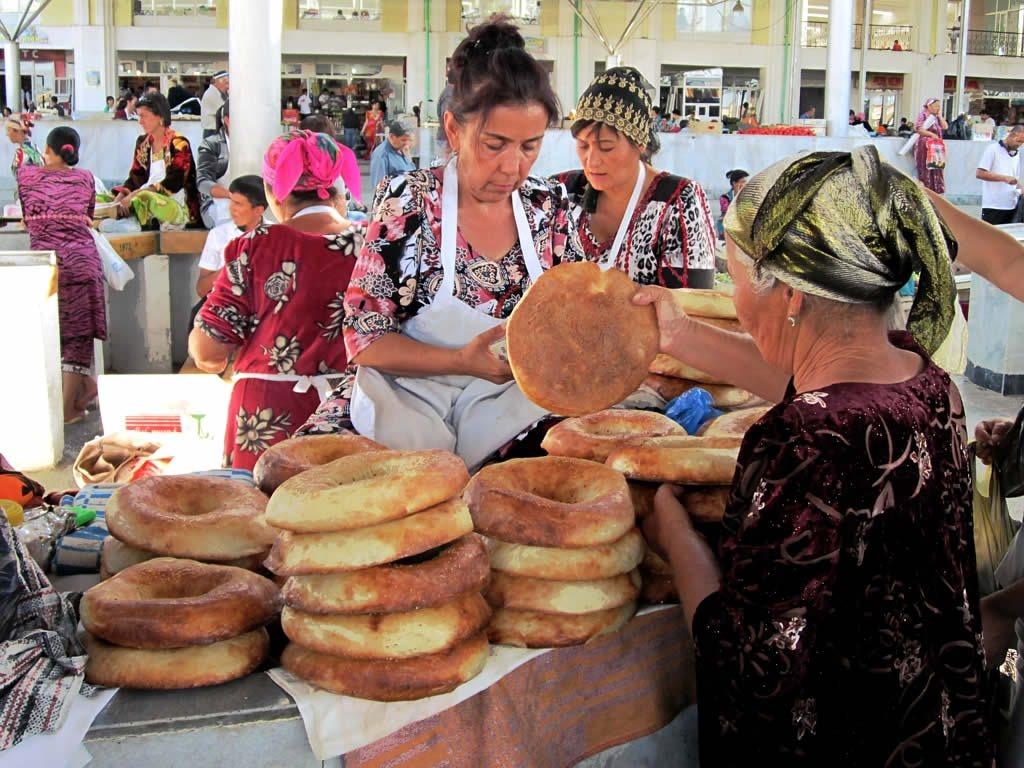
It is possible, but it takes some effort, because most traditional dishes contain meat. Good options include fresh bread (non), salads, vegetable or pumpkin samsa, soups without meat, dairy dishes and the excellent fruit and nuts in the bazaars. Learn the phrase “go’shtsiz” (Uzbek) or “bez myasa” (Russian), both meaning “without meat”. It is easier in Tashkent and Samarkand and hardest in the Pamirs.
Is the tap water safe to drink?
No. Drink bottled or boiled water, or use a filter bottle or purification tablets, in both countries. Bottled water is cheap and easy to find in cities. Bring stomach remedies and oral rehydration salts, as minor stomach upsets are common on longer trips.
Solo, women and LGBTQ+ travellers
Is it safe to travel solo, and as a woman?
Many solo travellers, including women, travel in both countries and find people friendly and helpful. Unwanted attention can happen, especially in rural areas, and the US State Department notes reports of harassment of women in Tajikistan. Dress modestly outside big cities, use taxi apps or booked transfers at night, and choose your own room in guesthouses where possible. On night trains, compartments are mixed; some women prefer the open carriage or book a whole compartment. For the Pamirs, a shared tour is a practical way to travel solo with others.
What should LGBTQ+ travellers know?
In Uzbekistan, sexual relations between men are illegal and can be punished with up to 3 years in prison. In Tajikistan, same-sex relations are not illegal, but society is conservative, and the US State Department reports cases of harassment and police attention. In both countries, avoid public displays of affection; this applies to all couples outside the big cities.
Costs, tours and language
How expensive is a trip?
Uzbekistan and Tajikistan are good value compared with Europe, but prices have risen in recent years. Some examples: an Economy ticket on the high-speed train from Tashkent to Samarkand costs about USD 26, an Uzbek e-visa costs USD 20 for nationalities that need one, and a guided walking tour in Bukhara or Khiva with us costs from about USD 50 per person. The Pamir Highway is the most expensive part of most trips, because you need a 4x4 and driver for a week. Your total depends mostly on hotel level and how much private transport you use.
Should I book a tour or travel independently?
Uzbekistan is easy to travel independently: trains are good, taxi apps work and hotels register you automatically. The parts where help is most useful are getting train tickets in high season, reaching places trains do not go (the Khorezm fortresses, Shakhrisabz, the Seven Lakes), and organising border crossings. In Tajikistan, especially in the mountains and the Pamirs, most visitors use a driver or a tour because public transport is limited. A mix works well: travel on your own in the cities and book transfers, day tours or the Pamir trip where logistics are harder.
Do people speak English?
Not much outside hotels, tourist restaurants and the main sights. In Uzbekistan the main languages are Uzbek and Russian; in Tajikistan they are Tajik and Russian, with Kyrgyz spoken around Murghab and Pamiri languages such as Shughni and Wakhi in the western Pamirs. Younger people in the cities often speak some English. A translation app with offline languages helps a lot. We can arrange guides in English, Russian and, depending on the city and date, Spanish, French and Italian.
Photography and drones
Can I take photos freely?
Mostly, yes. The monuments, bazaars and the Tashkent metro (where the old photo ban was lifted in 2018) are fine to photograph. Do not photograph military sites, border posts, checkpoints, airports, police or government buildings. Always ask before photographing people, especially women and children; most people say yes if asked politely.
Can I fly a drone?
In practice, no, unless you have official permission arranged in advance. Uzbekistan generally prohibits importing drones, and undeclared drones are confiscated at the border. Tajikistan requires prior government permission and registration with the security services. If drone footage matters for your project, contact the authorities, or ask us, well before your trip.
Plan your trip with TravelX
TravelX is a licensed tour operator based in Tashkent (Hilal Biz LLC). We arrange private and group tours, transfers, multi-day itineraries and guides across Uzbekistan and Tajikistan, from daily walking tours in Tashkent, Samarkand, Bukhara and Khiva to Seven Lakes day trips, Fann Mountains tours and the 7-day Pamir Highway. If you have a question that is not answered here, send it to us. We are happy to give honest advice for your route and dates, even if you plan to travel on your own.
- Website: travelx.uz
- WhatsApp / phone: +998 97 652 25 25
- Email: info@travelx.uz
- Instagram: @travelx_uz
This FAQ is general information. Visa, entry and safety rules can change at short notice. Always check official sources and your government’s travel advice before you travel.
Sources
TravelX journal guides (fact-checked 19 October 2026):
- Uzbekistan Visa Rules: The Complete 2026 Guide
- Tajikistan Visa Rules: The Complete 2026 Guide
- Trains in Uzbekistan: The Complete 2026 Guide
- What to Wear and Pack for Uzbekistan and Tajikistan: A Season-by-Season Guide
- Uzbekistan Land Border Crossings: 2026 Guide
- Tajikistan Land Border Crossings: 2026 Guide
Official and government sources:
- US State Department, Uzbekistan travel advisory (Level 1, January 2026)
- US State Department, Tajikistan country information (Level 2, September 2026)
- UK FCDO, Uzbekistan safety and security
- UK FCDO, Tajikistan regional risks (updated August 2026)
- Official Uzbekistan e-visa portal
- Official Tajikistan e-visa portal
- Consular Department of the MFA of Tajikistan, entry rules
- E-mehmon registration system
- Uzbekistan Railways official ticketing
News and practical sources:
- UzDaily, IMEI registration in Uzbekistan (October 2026)
- Kun.uz, how to bring a phone into Uzbekistan and register its IMEI (March 2026)
- Kun.uz, Jaloliddin Manguberdi high-speed train to Khiva (May 2026)
- RFE/RL, Tashkent metro photo ban lifted (2018)
- Travel With Hello, Uzbekistan currency and tipping guide (May 2026)
- ATM Fee Saver, cash and ATMs in Tajikistan (updated 2026)
- Bento Travel, ride-hailing in Tajikistan (August 2026)
- Journal of Nomads, Is Tajikistan safe to travel in 2026?
- Global Gaz, Pamir Highway: what you need to know
- Eurasia.Travel forum, day trip to the Seven Lakes
Demand research (where the questions came from):
- Tripadvisor Uzbekistan forum
- Tripadvisor Tajikistan forum
- Eurasia.Travel forum, Uzbekistan
- Eurasia.Travel forum, Uzbekistan transport
- Eurasia.Travel forum, Uzbekistan visas and borders
- Eurasia.Travel forum, Tajikistan
- Eurasia.Travel forum, Tajikistan visas and permits
- Eurasia.Travel forum, Tajikistan transport
- Mumsnet, Uzbekistan advice for a first-timer
- Lonely Planet, things to know before travelling to Uzbekistan